Financial sextortion of adults is a rapidly escalating cyber-enabled fraud exploiting Americans and generating millions of dollars in profit for transnational criminal organizations.
What is Financial Sextortion?
Financial sextortion is a form of online blackmail where perpetrators obtain explicit images of the victim and blackmail the victim for money.
Financial sextortion was the most reported cyber-enable fraud in 2025 across all age groups to the FBI’s Internet Crime Complaint Center (IC3). The article below primarily examines 2025 FBI IC3 financial sextortion data to identify adult victim demographics, losses, and ransom payment details.
The FBI defines “cyber-enabled fraud” as complaints where criminals use the internet or other technology to commit fraudulent activities, often involving the theft of money, data, identities, or the creation of counterfeit goods or services.
Cyber-enabled frauds include investment scams, non-payment / non-deliver of goods purchased online, tech support scams, and government impersonation scams. More financial sextortion reports were filed in 2025 than any of the other types of scams.
Surge of Financial Sextortion of Adults
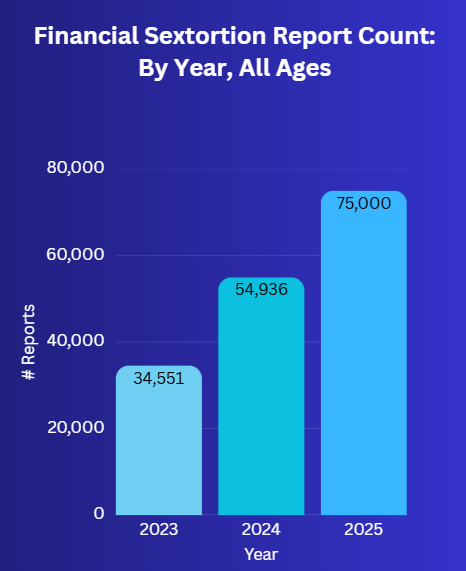
Sextortion reports to IC3 more than doubled from 2023 to 2025. In 2025, there were more than 75,000 financial sextortion reports filed with IC3 while only 34,551 were reported two years earlier.
Financial Sextortion of Adults Surpasses Other Cyber Frauds
- Have you heard about the toll road text message scam?
- Have you watched a Hulu documentary about romance scams?
- Have you been warned about fake job scams?
Those three cyber-frauds examples have received significant attention, yet fewer complaints were filed with the FBI about those crimes than about financial sextortion.
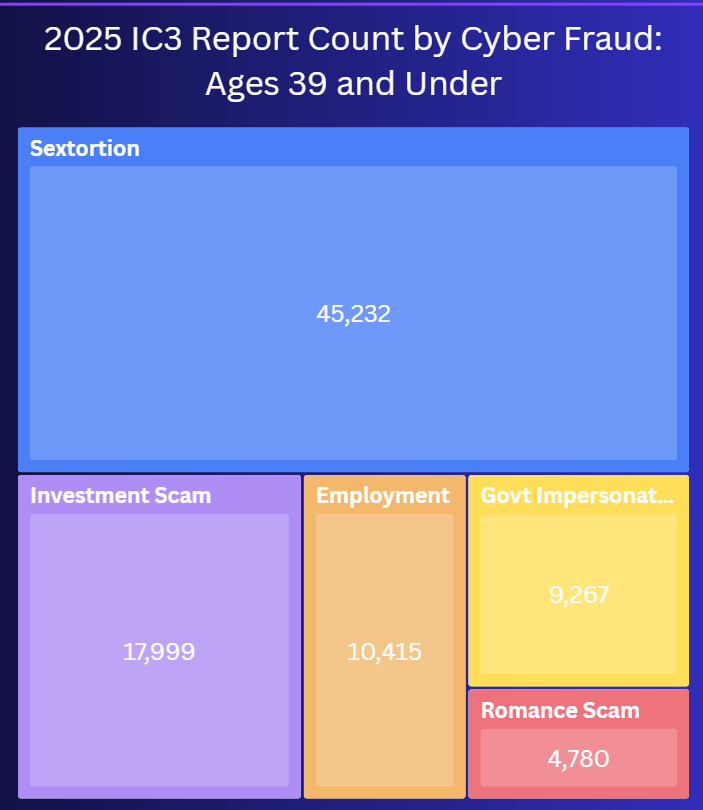
For example, people in their 20’s and 30’s reported more financial sextortion than investment, employment, government impersonation, and romance scams…combined.
FINANCIAL SEXTORTION VICTIM DEMOGRAPHICS
Young Adults Lead Financial Sextortion Reporting
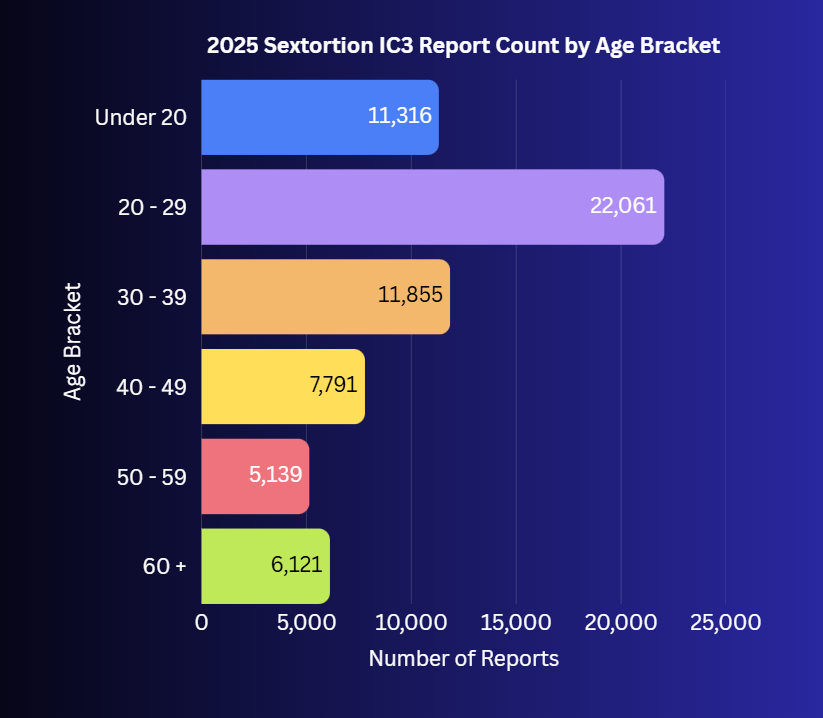
While much of the focus (including my own research) has been on financial sextortion of minors, it is important to understand the perpetrators target all ages. Financial sextortion was the most reported crime for two age brackets: Under 20 and 20 to 29. Financial sextortion was the second most reported cyber-enabled fraud for ages 30-39.
People in the 20s filed twice as many financial sextortion complaints as individuals Under 20. People ages 30 to 39 filed nearly an equal number of sextortion reports as those Under 20. A 2024 survey by SnapChat found that 46% of young adults ages 18 to 24 who were victimized by sextortion received demands for money or gift cards.
Financial Sextortion of Minors Likely Reported to IC3
In 2025, IC3 referred more than 5,700 submissions involving minors to the National Center for Missing and Exploited Children (NCMEC). However, it is unclear how many of those referrals involved financial sextortion. For comparison, there were over 36,000 financial sextortion of minors reports filed directly with NCMEC in 2024.
Older Adults, ages 60+ filed more financial sextortion reports than…
- Identity Theft
- Credit Card/ Check Fraud
- Business Email Compromise
- Lottery/ Sweepstakes/ Inheritance scams
Yet, there is a dearth of government warnings, advisories, or resources tailored to seniors about of financial sextortion. For example, the March 2026 United States Senate Special Committee on Aging report titled “Age of Fraud: Scams Facing Our Nation’s Seniors” makes no mention sextortion.
In contrast, AARP provides several articles and resources about sextortion. AARP reports that its Helpline “receives a steady stream of calls from older sextortion victims.”
Seniors Incur the Highest Losses from Sextortion
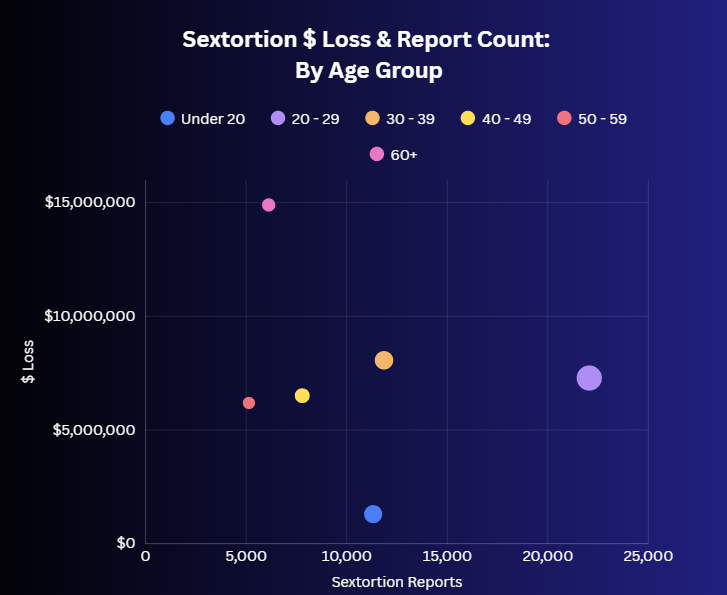
While the 20 to 29 age bracket filed the most sextortion reports, people 60 years old and over reported the largest loss with approximately $15,000,000 extorted. Seniors lost on average $2,433 to financial sextortion while those ages 50 to 59 lost on average $1,203. Financial sextortion reports filed by people Under 20 lost on average $114.
Unknown Gender Break-Down of Financial Sextortion of Adults
The IC3 data is not broken down by gender. However, we do know that financial sextortion of minors primarily targets boys. Additional research and data are needed to determine if the same gender pattern is also found among adults experiencing financial sextortion.
Understanding the gender dimension of financial sextortion (and other cyber-enabled frauds) will help better target consumer awareness campaigns and could better tailor transaction monitoring scenarios.
Financial Sextortion Integrated with Other Cyber Scams
INTERPOL
The 2026 INTERPOL Global Financial Threat Assessment warned that financial sextortion is now being integrated into other types of cyber-enabled frauds such as romance and investment scams.
INTERPOL noted, “reports from trafficked victims forced to work in scam centres reveal that while fraud strategies and scripts typically follow investment fraud tactics, if these prove to be unfruitful, instructions are to pursue methods of sextortion.”
As romance and investment scams typically target adults, this may partially explain the rapid growth in financial sextortion of adults.
Additionally, Darrin Jones of INTERPOL highlighted romance fraud AND sextortion as one of the top fraud types common across all regions during his opening remarks at the United Nations / INTERPOL 2026 Global Fraud Summit.
I also presented my research and recommendations regarding the financial mechanisms of financial sextortion of minors at the United Nations / INTERPOL 2026 Global Fraud Summit.
FTC
Similarly, in 2023, the FTC linked romance scams with financial sextortion. The FTC noted in relation to romance scams, “Reports also show that scammers who convince you to share explicit photos will then threaten to share them with your social media contacts.”
The FTC identified romance scam reports involving sextortion by using keyword analysis of the narratives provided in the reports. The FTC’s analysis of 2022 data found that people ages 18-29 were six times as likely to report sextortion as those 30 and over.
Ransom Payment Methods in Financial Sextortion of Adults
The 2025 IC3 Annual Report did not provide detail on the victim payment methods for sextortion. However, sextortion is a sub-set of the “Extortion” category which did include some payment details.
Cryptocurrency and Adult Financial Sextortion
Extortion losses totaled $122M+ with sextortion accounting for at least $44M of the total. Of the 89,129 Extortion complaints, 75,000 were about sextortion. Therefore, only 14,129 Extortion reports were unrelated to sextortion.
Over 26% of Extortion complaints had a nexus with cryptocurrency. $63 million (52%) of extortion ransom was paid via cryptocurrency.
At least 12% of sextortion complaints paid ransom via cryptocurrency. IC3 reported that 23,797 Extortion complaints paid via crypto. Even if all 14,129 Extortion reports unrelated to sextortion paid ransom via crypto, that would leave 9,668 sextortion reports that must have used crypto to pay the blackmailer.
Crypto ATMs & Sextortion
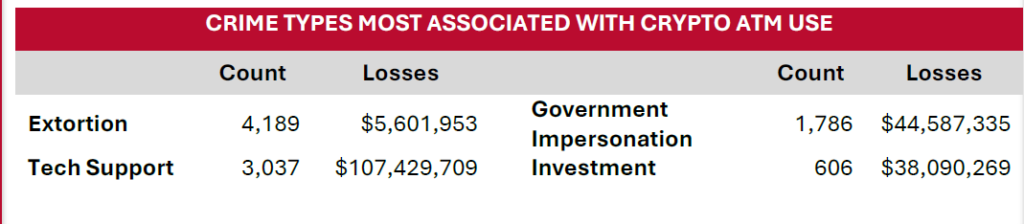
Additionally, in 2024 the FBI reported that Extortion was the most frequently reported cybercrime associated with Crypto ATM use. Over 4,000 extortion complaints paid $5.6 million via crypto ATMs in 2024. It is unclear what portion of the Crypto ATM Extortion complaints or dollar values were linked to sextortion ransom.
More Research & Data Are Needed
Financial sextortion of adults has received less media and research attention than financial sextortion of minors, which is also under-examined.
While NCMEC collects and analyzes financial sextortion data for minors such as perpetrator location, social media platforms used, and ransom payment methods, the same type of detailed information is not collected for adults.
My analysis of the financial mechanisms of teen sextortion examined four steps in sextortion money flows: (1) victim payments, (2) domestic consolidating & laundering, (3) international remittance, and (4) perpetrator use of funds. The same type of analysis is needed for the financial flows of adult sextortion funds.
Questions about financial sextortion of adults remain such as…
- Are the perpetrators the same as those targeting children?
- Do perpetrators target adults and teens differently? Or prefer to target one over the other?
- Where are the perpetrators located?
- Are the perpetrators coerced (i.e. human trafficking victims) or willing participants?
- Adults have a wider array of financial products available to them than children. Do adults pay ransom differently?
- If adults pay sextortion ransom via financial products that can easily be transferred overseas (ex. bitcoin or wire transfer), does that reduce the role and reliance on domestic money mules?
- If adults pay sextortion ransom via financial products that are limited to domestic use (ex. P2P), are those methods similar or different that teens? For example, teens are often told to pay with a gift card, are adults?
I invite others to delve into these questions about financial sextortion of adults.
Resources for Adult Victims of Financial Sextortion
Sextortion Advice and Guidance for Adults: Internet Watch Foundation
FBI Warning: For-Profit Companies Charging Sextortion Victims for Assistance and Using Deceptive Tactics to Elicit Payments.
AARP Helpline 877-908-3360
Anyone Can Become a Target for Sextortion– AARP
Guide to Removing Intimate Images Online – CCRI
___________________________________________________________________________________
Dynamic Securities Analytics, Inc. provides litigation consulting to help clients successfully navigate disputes involving securities, cryptocurrency, and money laundering.