Addressing Crypto’s Most Persistent Blind Spots
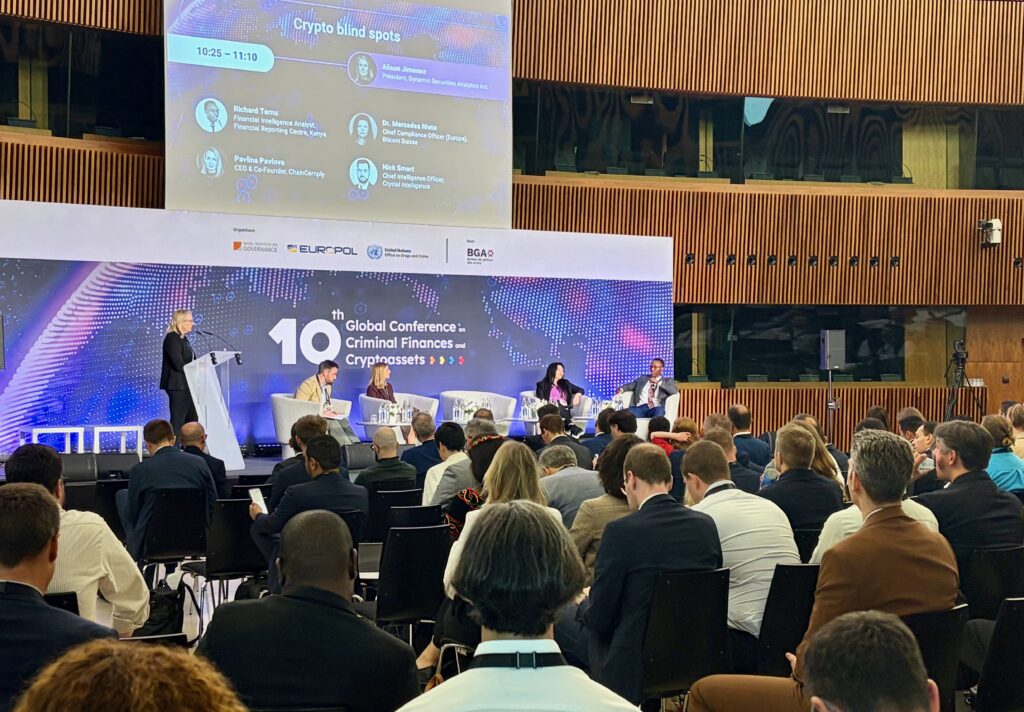
At the 10th Global Conference on Criminal Finances and Cryptoassets, Dynamic Securities Analytics president Alison Jimenez, joined international law-enforcement and financial-crime professionals to examine some of the most difficult challenges in cryptocurrency investigations. The conference was jointly organized by Europol, UNODC, and the Basel Institute of Goverence.
In the “Crypto Blind Spots” panel, moderated by Alison Jimenez, experts explored how criminals exploit the limits of blockchain visibility. While public blockchains can provide some transaction records, illicit actors increasingly use methods designed to complicate investigations and obscure the movement of funds.
These methods can include:
-
Moving funds through decentralized finance platforms and other complex transaction pathways
-
Conducting activity inside centralized exchanges, where transfers may not create a public on-chain trail
-
Converting cryptocurrency through crypto-linked debit cards
-
Using peer-to-peer transactions and money mules to distance offenders from illicit proceeds
The discussion reinforced a central reality for investigators: blockchain data is helpful, but it is not complete on its own. Effective investigations require the ability to combine blockchain intelligence with exchange records, payment data, open-source information, investigative expertise, and international cooperation.
Crypto’s Blind Spots: Why Blockchain Intelligence Standards Matter
Alison Jimenez also contributed to the Europol UNODC cryptoassets conference breakout session on Blockchain Intelligence Standards. As cryptocurrency legislation increasingly requires—or encourages—the use of blockchain analytics, the field faces a significant gap: there are still no broadly accepted technical standards, quality standards, or shared terminology for blockchain intelligence.
Clearer standards can improve the consistency, transparency, and evidentiary value of blockchain-based financial investigations. They can also help investigators trace and disrupt the movement of crypto proceeds connected to serious crimes, including the financial sextortion of minors and the transfer of illicit funds across borders.
The conference, organized with support from UNODC, Europol, Luxembourg BGA, and the Basel Institute on Governance, brought together practitioners from around the world to address the evolving intersection of cryptocurrency and financial crime.
_____________________________________________________