Cartel Terror Finance Risks for Financial Institutions After FTO Designations
Dynamic Securities Analytics President Alison Jimenez recently commented to Washington Post Intelligence on terrorist-financing risks 25 years after the September 11 attacks.
Since early 2025, 21 Latin American cartels and Caribbean criminal groups have been designated as Foreign Terrorist Organizations (FTOs). This change creates a more complex operating environment for banks, money-services businesses, payment providers, peer-to-peer platforms, crypto firms, and other financial institutions.
Cartel and Drug Trafficking Organization Finance
Drug-trafficking organizations generate billions of dollars in illicit proceeds. However, identifying drug-related SAR data has long been difficult due to the lack of a dedicated category on the SAR form.
Cartel funds can move through cash-intensive businesses, bank accounts, cross-border remittances, payment applications, digital-asset services, money mules, and professional money laundering networks. As a result, activity previously viewed primarily as drug trafficking or money laundering risk may now also raise terrorist financing, sanctions, and potential material-support concerns.
Cartel Terror Finance Risks not Reflected in SAR Filings
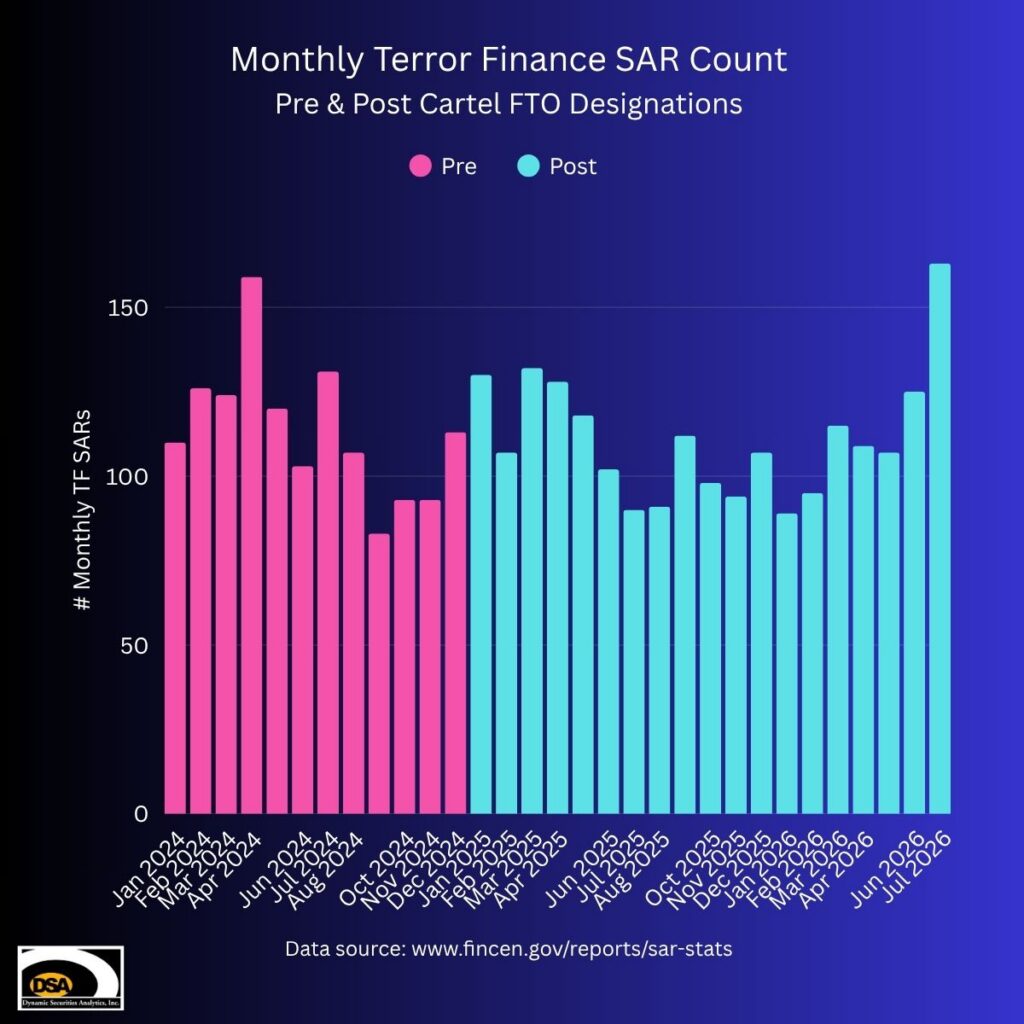
At the same time, Suspicious Activity Report filing counts for terrorist financing have not increased in line with this changing risk environment. In 2024, before the Latin American cartel and Caribbean criminal groups were designated FTOs, financial institutions filed on average 113 terror finance SARS. The average number of terror finance Suspicious Activity Reports filed after the designations were 109 in 2025 and 114 through July 2026.